
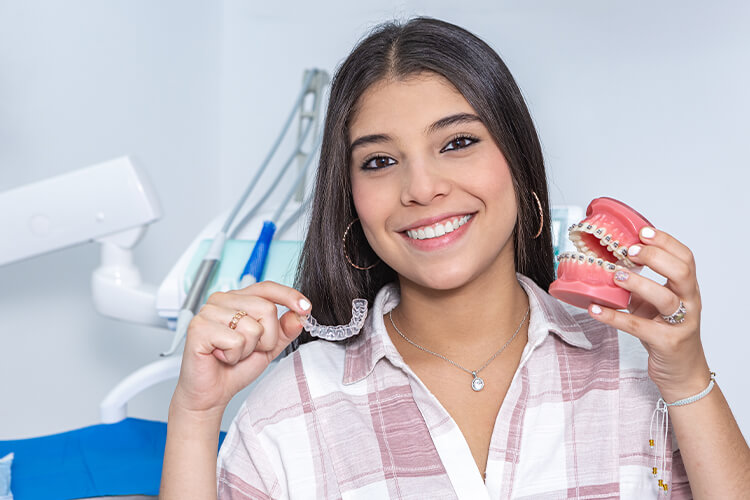
Choosing between clear aligners and fixed braces is a big decision. Both can straighten teeth beautifully, but they suit different lifestyles, timeframes and clinical needs.
At Only Orthodontics in Huddersfield, our Specialist Orthodontists treat children, teens and adults with both systems every day. This guide shares how we help you decide, what day-to-day life really looks like with each option, and practical tips if things go off-plan.
What matters most when choosing
The right appliance is the one that fits your goals, your routine and your bite. In clinic we look at three things.
Clinical complexity
Some tooth movements are simple, others need precision control.
Lifestyle priorities
Visibility, eating, sport, music, work or school commitments all matter.
Commitment
Removable appliances work brilliantly when worn as prescribed; fixed options remove the temptation to take a break.
We offer discreet choices on both sides. Clear aligners include Invisalign® and Angel Aligners. Fixed options include metal and aesthetic ceramic braces.
Visibility and first impressions
Clear aligners are almost invisible at conversational distance. For many adults in client-facing roles, this is the main reason to choose them. Teen patients often like the subtle look for photos and social events.
Fixed braces are always on show, but ceramic brackets blend with natural tooth colour and are far less noticeable than metal. Elastics can be clear or tooth-coloured for a cleaner look. If you want zero effort around wear time and do not mind some visibility, aesthetic fixed braces offer a good balance.
Eating, drinking and speech
With clear aligners you remove the trays to eat and to drink anything other than cool, still water. Hot, coloured, acidic or sugary drinks can warp or stain aligners and increase decay risk if sipped with aligners in. The upside is that you can enjoy your usual foods when the aligners are out, then brush and pop them back in.
Fixed braces stay in place for meals. You will need to avoid very hard, chewy or sticky foods and chewing gum to protect the appliance. Cut firm foods into smaller pieces and take extra time with cleaning. Speech is rarely affected after a short settling period with either option. Some people notice a slight lisp with aligners for a few days; this usually settles quickly as you adapt.
Daily wear time and treatment timelines
For aligners to work, consistency is key. You will typically wear them around 22 hours per day, removing only for meals, hot drinks and brushing. Aligner changes are usually every 7 to 14 days depending on your plan.
Fixed braces do not rely on daily wear decisions, so they suit patients who want set-and-forget progress. Average timelines vary by case. Many fixed-brace treatments run around 18 to 24 months. Aligner timelines can be similar for comprehensive treatment, but simpler alignment can sometimes be quicker. Your written plan will outline what to expect after we complete records and 3-D scans.
Appointment frequency and what to expect
Most patients are reviewed every 8 to 10 weeks whether wearing aligners or braces. Aligners may include remote check-ins when appropriate, but we still like to see you in person at sensible intervals to track health and progress.
Fitting fixed braces typically takes 30 to 40 minutes. Routine brace checks are usually short. Aligner handovers include care instructions and your next sets. Whatever you choose, you get a clear schedule, practical advice and direct access to our team if you need help between visits.
Suitability: simple vs complex cases
Clear aligners are excellent for many mild to moderate issues, including crowding, spacing and certain bite corrections. With careful planning and the right attachments, aligners can manage more complex movements too.
Fixed braces remain the most versatile tool for significant rotations, severe crowding, vertical changes and detailed bite-tuning where constant control helps.
In your face-to-face assessment we take photographs, a 3-D scan and x-rays to map tooth positions, roots and bone. From there, our Specialist Orthodontists will recommend the approach that gives you the most predictable route to the smile you want.
Lifestyle fit: sport, music and busy diaries
If you play contact sport, aligners can be removed and a mouthguard used. Instrumentalists often find aligners more comfortable than braces on lips and cheeks, though most brace wearers adapt with wax and practice. For very busy schedules, aligners offer flexibility around meal breaks and travel, but only if you are diligent about the 22-hour goal.
Fixed braces keep treatment moving on days when life is hectic. There is no risk of forgetting to put them back in after lunch or a meeting.
Troubleshooting: lost or broken aligner
Life happens. Here is what to do if an aligner goes missing or cracks.
Try your next aligner. If it fits comfortably, move on and wear as directed.
If the next one does not fit, go back to the previous aligner to hold position.
Contact our Huddersfield practice promptly so we can advise and, if needed, order a replacement.
For discomfort or a rubbing edge, use orthodontic wax or a smooth emery board to lightly soften a sharp corner on the tray, then let us know at your next review.
How our Specialists help you decide
Decision-making is a partnership. We start with a free initial consultation call with a Treatment Coordinator to understand your goals and answer early questions. If you choose to proceed, a chargeable in-person assessment with a Specialist Orthodontist at our Greenhead Road clinic includes full diagnostics, a written plan, timescales and options.
You will have time to think it over and talk through finance choices if helpful.
If discretion is your priority, we will explore Invisalign® or Angel Aligners alongside aesthetic fixed braces. If precision control is critical for your bite, we will explain why fixed braces could be the better choice. We tailor treatment around your lifestyle, not the other way round.
If you want to dig into appliance options, read more about our fixed brace choices for adults on our site, or explore our clear aligner treatments available in Huddersfield. We are here to guide you to the right fit.
FAQs
Are clear aligners right for me, or should I choose fixed braces?
It depends on your goals, your commitment to wearing aligners around 22 hours per day and the complexity of your bite. Aligners suit many mild to moderate cases and those wanting a discreet, removable option. Fixed braces are typically best for complex movements and for anyone who prefers a solution that does not rely on daily wear discipline.
How long do aligners take and how often do I wear them?
Aligner schedules vary by case, but many comprehensive plans are similar in length to fixed braces. You will usually wear aligners around 22 hours each day, removing only for eating, hot drinks and brushing.
What are the check-up intervals, and what if I lose an aligner?
Reviews are commonly every 8 to 10 weeks. If you lose an aligner, try the next one. If it fits, continue; if not, step back to the previous tray and contact us for guidance.
Can adults and teens both use aligners?
Yes. We treat both adults and teenagers successfully with aligners when the case is suitable and the patient can commit to wear-time. For some teen cases, fixed braces remain the most efficient choice.
Summary and next step
Both clear aligners and fixed braces can deliver confident results. Aligners offer near-invisibility and mealtime freedom, provided you commit to around 22 hours of wear each day. Fixed braces provide round-the-clock precision and remove the risk of forgetting to wear your appliance, with aesthetic ceramic options to keep things discreet.
Not sure which way to go? Book a free initial consultation call with Only Orthodontics in Huddersfield and we will map out your options, timelines and likely costs, then let you choose with confidence.